This morning I work up bright and early at 8 am (don’t roll your eyes) to get the final vaccination in a series at the doctor’s office. Nothing sucks more than waking up early to go get a shot in the arm. ANYWAY, the LAST thing I expected to see when I left Northwestern Memorial’s doctors offices was to see the Historic Water Tower on fire. Yes, ON FIRE. Isn’t this the building that survived oh, I don’t know, the Great Chicago Fire of 1871?
I couldn’t resist photographing this firefighter. He’s actually a Lieutenant and was directing the emergency response. They’re all super hot by default. I simply adore firefighters, there’s nothing sexier than a man who will run into burning buildings to save random strangers.
Read the Chicago Tribune article here.

Friday, June 3rd, I am presenting a paper at the annual American Marketing Association’s Public Policy Conference in Washington, D.C. The study itself is titled “Effects of Sustainability Labeling and Consumer’s Response on Clothing: A Pilot Study.” The goal was to investigate consumer decision-making with regard to the sustainability of apparel disposal. Consumer attitudes towards the sustainability of production are well documented and easier to measure. What is far more difficult to measure is the long-lasting impact of an article of clothing after it has been used.
This is an enormous privilege because all presentations are peer reviewed through a double-blind process. This means that neither the reviewers nor reviewees know the names of the people who wrote the paper or reviewed the submission, so everyone’s work is truly judged only on its scholarly merit and not on the identity of the authors. I co-authored the study with my friends (and PhD candidates) Anastasia Thyroff, Christopher Newman, and Yoo-Na Cho. It is difficult for tenured professors to get their papers accepted at conferences, so I am overjoyed to be presenting our work as a Master’s student. Several senior executives from various federal agencies including the EPA, FDA, USDA, Treasury Department, and many more will be attending to learn from the world’s experts on marketing and public policy. It is almost unheard of for a Master’s student to present at this conference so I am truly, truly honored to have the opportunity to share my research with thought leaders from prestigious universities and the federal government.
We performed an experiment on 120 undergraduate students and ran a conjoint analysis on the resulting data. We asked them a large number of questions (all on Likert scales) to measure consumer motivation, attitudes toward the environment, and behavior reports. We wanted to see how product labeling on apparel influences the consumer’s decision-making process. For our study we analyzed Patagonia’s Common Threads labeling system. The Common Threads label indicates that a garment can be recycled into future clothing, thereby drastically reducing a garment’s impact on the environment and preventing it from becoming landfill. A stunning 12 million pounds of textile waste is generated annually in North America, which works out to 68 pounds of clothing sent to the landfill for each household every year. Clothing sustainability is a huge environmental issue and one I’m excited to work on.
What we found was very interesting. Consumers prefer to think about product sustainability as having “already happened.” By that I mean people want to buy a good that is already sustainable – they don’t want to think about the sustainability of the actual usage, and even less about product disposal. The consumers who do think about long-term product sustainability (usage and disposal) tend to operate at a higher cognitive level than those consumers who do not. We were able to ascertain this using psychological measurements on the surveys. A lot of you are probably saying “duh, of course smart people think better and treat the environment with more respect.” But what we want to do is change the way the average “Jane” thinks about purchasing her clothing. Labeling is one method of influencing consumer purchasing habits.
So see, it IS possible to study Public Policy AND Fashion! I am both an academic and a fashion-lover to the bone, and it was a privilege to be able to combine my two great passions in this one research study. I’m looking forward to collaborating on future research into sustainability and the fashion industry!
The personal side of this story is how my own shopping patterns influenced this research. Those of you who know me know that 99% of my clothing purchases are either 1) designer clothing with high price points, selected carefully to integrate with the rest of my wardrobe and pieces that I treasure forever or 2) used or vintage clothing from a consignment store. Vintage clothing is obviously the most sustainable way to buy apparel. I rarely shop at H&M or Zara, and when I do I buy things to wear for multiple seasons. I really dislike the “throwaway” culture of fast-fashion, of buying ultra-cheap shoddily made apparel that rips and falls apart in one season only to be replaced in 6 months. Then there is the whole idea – the heart and soul of the fashion industry – of supporting independent design houses like Rodarte, Thakoon, and Proenza Schouler. True artists whose creations represent a moment in time, yes, but whose pieces are made to be worn for a lifetime. True design is eternal, and never goes out of season. When a consumer buys a garment that is a piece of art, and is priced accordingly, the fact is they treat it – and the environment – with a lot more respect.
So the next time you’re out shopping for clothing, think to yourself – how sustainable is the USAGE and the DISPOSAL of the garment, and how long will it last? If you buy clothing to treasure it, to archive it, and to collect it, then you can rest assured that you are already practicing sustainable fashion!!

Unless you’ve been living under a rock, you know by now that London’s biggest “high street” store TOPSHOP is opening its second American location here in the Windy City. Construction has been underway at the Michigan Avenue location at the corner of Pearson in the old Borders space. TOPSHOP is known for its fashion forward designs, celebrity following, and designer collaborations.
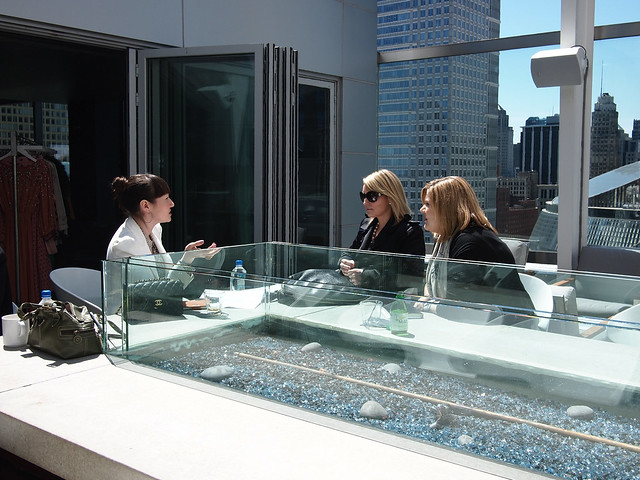
I was invited to preview TOPSHOP’s newest collections at their private industry preview event this past Wednesday at theWit hotel’s rooftop lounge overlooking the city. TOPSHOP is planned to open this fall in early September 2011 at 830 North Michigan Avenue. The sales floor will be 35,000 sq. ft. with a DJ booth and open ceiling.
TOPSHOP executive Karen, who is based in London but flew in for the event, graciously showed me every single piece in each of their four collections; Psychobilly; Thrift; Glamrock; and Bavaria. In addition the Chicago location will carry Unique, an in-house designer line that shows each year at London Fashion Week. TOPSHOP Chicago will also include their entire men’s line TOPMAN. Lingerie, maternity, footwear, cosmetics, jewelry, and accessories will each have their own display area in the space.
I chose one to photograph one piece of clothing from Psychobilly, Glamrock and Bavaria, which you can see below:
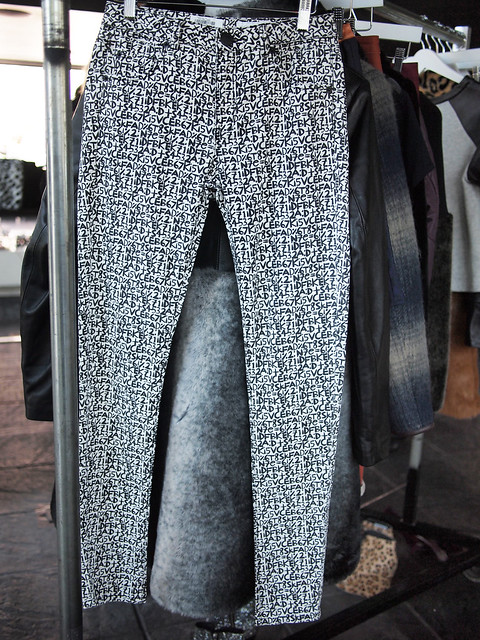
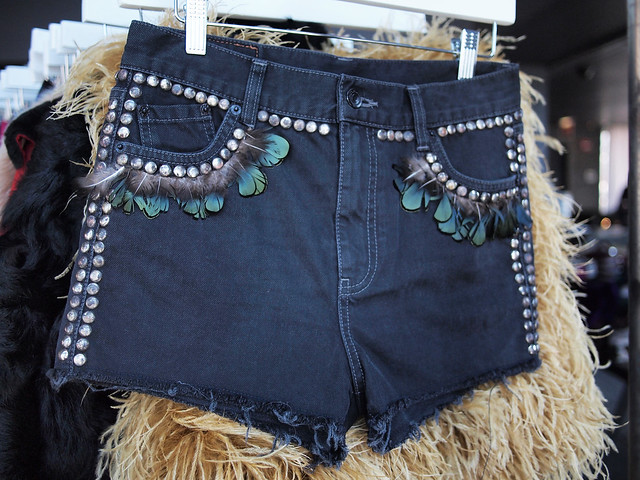
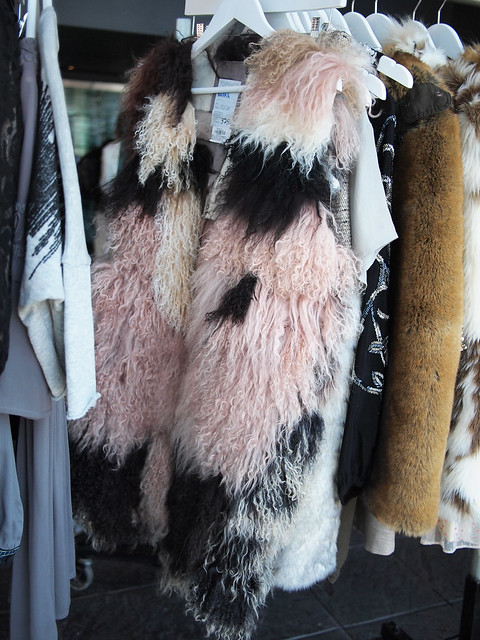
Mongolian lamb fur vest
Due to imitation and copying concerns each media outlet was only allowed to photograph three products. That is also why I chose not to post any photos of attendees inside since all of the products are easily visible. I respect the company’s desire to keep its designs secret in an industry where blatant copying is unfortunately all too common.
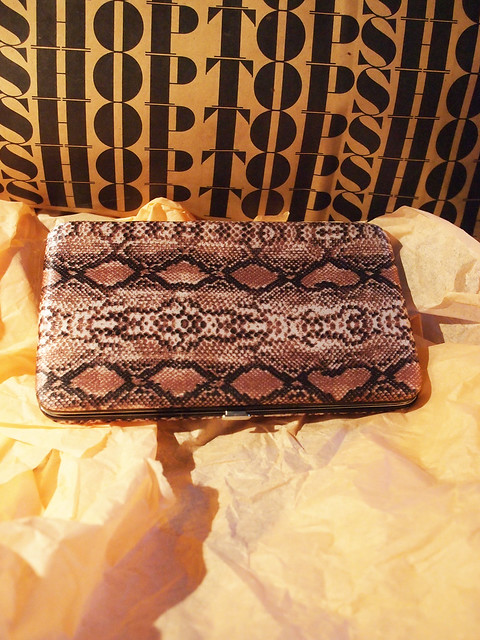
Special thank you to TOPSHOP for dropping off a surprise gift for me at my apartment building. I love my new snakeskin print clutch!